13 min read



Key Takeaways
- AI will make loyalty programs more predictive, personalized, and responsive.
- Predictive models will help businesses identify churn risks before customers leave.
- Rewards and offers will become more individualized based on customer behavior.
- AI agents could become a new channel for customers to access loyalty programs.
- First-party customer data will become increasingly important for personalization.
- Privacy, consent, transparency, and human oversight will become more critical.
- Small businesses can adopt AI gradually through practical loyalty automation.
AI is already changing how businesses understand and retain customers. By 2027, its role in loyalty programs is likely to move beyond basic automation and become much more involved in deciding which customers need attention, which rewards are relevant, and when a business should act.
The biggest change will not simply be more automated emails or notifications. Loyalty programs are moving toward systems that respond to individual customer behavior and, increasingly, predict what may happen next.
McKinsey's work on next-best customer experiences already shows how customer data, predictive models, recommendation systems, and generative AI can work together to decide which interaction may be most useful for an individual customer.
If you want to understand how these technologies are already being used today, our guide to how AI is transforming digital loyalty programs covers personalization, predictive analytics, gamification, and other current applications in more detail.
What Will Change in Loyalty Programs by 2027?
Traditional loyalty programs follow a simple pattern that most customers already recognize from paper stamp cards. A customer takes an action, the program records it, and a fixed reward eventually follows.
AI-assisted loyalty changes that sequence considerably. The system can learn from customer activity, identify patterns, estimate what may happen next, suggest an action, measure the response, and adapt over time.
The key shift is moving from reacting only to past purchases toward anticipating what a customer may need next.
Deloitte describes future loyalty as heading toward continuously evolving segmentation and decisioning rather than campaigns that react only after behavior has already happened.
8 AI Trends Shaping the Future of Loyalty Programs
These eight trends represent some of the clearest developments shaping AI-powered loyalty heading into 2027.
1. Loyalty Will Become Predictive
Today, a customer may stop visiting, the business notices weeks later, and a win-back offer finally goes out.
The future direction changes that timing.
A loyalty system could identify unusual behavior, such as fewer visits, longer gaps between purchases, lower spending, or unredeemed rewards, and estimate the likelihood that a customer may be becoming less engaged.
This makes proactive churn prevention more useful than relying only on win-back campaigns after customers have already disappeared.
McKinsey's work on next-best experience already points toward this type of proactive intervention rather than only reactive promotions.
Predictions will not always be correct. A customer might change their routine temporarily without intending to leave. The value lies in helping businesses notice meaningful changes earlier and decide whether action is necessary.
If lapsed customers are already a challenge for your business, our guide on how to win back inactive and lapsed customers covers practical strategies you can use today.
2. Hyper-Personalized Rewards Will Replace Broad Segments
Current personalization often looks broad, with VIP customers getting one offer, new customers another, and inactive customers a third.
The next stage moves toward something far more individual.
Instead of relying only on broad segments, loyalty programs can weigh things like purchase history, visit frequency, preferred time, typical spend, and past redemption behavior.
So instead of everyone receiving the same ten percent discount, one regular might get double progress on their usual coffee. Another could receive a free upgrade during their Tuesday visit, while a third gets a bonus reward because their visits have quietly declined.
Deloitte's 2025 loyalty survey found particularly strong interest in hyper-personalized loyalty among younger consumers, with 62% of Gen Z and 64% of millennials saying they would opt into these settings for better rewards.
3. AI Will Choose the Next Best Loyalty Action
This goes a step beyond simple personalization.
Instead of a marketer deciding to send one customer segment a promotion on Friday, AI can help work out what the best action is for a particular customer at that moment.
That could mean sending a reward, reminding someone about their existing progress, recommending a product, triggering a win-back message, or inviting them into a higher loyalty tier.
Sometimes, the smartest action may be to send nothing at all.
That is what makes next-best-action decisioning different from simply automating more campaigns. The goal is not to send more messages, but to understand when an interaction is actually useful.
This type of decision-making is already being developed by major organizations and is likely to become more common in loyalty as customer data and predictive tools improve.
4. Rewards Could Become Dynamic Instead of Fixed
Traditional loyalty math tends to look fixed, such as ten visits earning one free coffee every time.
The emerging direction lets reward structures adjust based on customer behavior, value, churn risk, inventory, time of day, and business demand.
A restaurant facing weak Tuesday traffic might give a Thursday regular bonus progress specifically for visiting on Tuesday, while a different customer receives an entirely different offer based on their own behavior.
Dynamic does not mean unfair or random.
Businesses still need clear earning rules customers can rely on, and AI works more safely around bonus offers than around constantly changing the value of rewards already earned. If the basic reward structure is not working, our guide on why loyalty programs fail and how to fix them covers the most common problems.
5. Generative AI Will Make One-to-One Loyalty Communication Scalable
Today, most businesses write one push notification, one email, and one offer description for thousands of members at once. Generative AI can increasingly create variations based on customer interests, purchase history, lifecycle stage, preferred product, and channel, so a brand-new member and a long-term regular no longer receive identical messaging.
This makes it easier to personalize communication across a large customer base without manually creating every variation.
Personalized content alone is not the same as genuinely intelligent loyalty, since the underlying offer and its timing still need to be relevant.
6. AI Agents Could Become a New Loyalty Gatekeeper
AI shopping agents may increasingly compare products, prices, loyalty balances, and rewards for consumers. They could also recommend redemptions, help choose between offers, and eventually complete purchases.
EY argues that agentic commerce will require brands to redesign loyalty and promotions around how AI agents make decisions.
This means loyalty programs will need clear rules, transparent rewards, structured data, and reliable integrations that both customers and AI systems can understand.
7. Loyalty Data Will Become More Valuable and More Sensitive
AI is only useful when the data feeding it is accurate and current, and future loyalty systems will depend increasingly on first-party signals such as purchases, visit patterns, reward behavior, and stated preferences. This makes loyalty programs considerably more valuable as a source of consented first-party behavioral data.
Collecting more data should never be seen as automatically better. What matters more is explicit consent, data minimization, clear customer controls, and being able to explain plainly why information is being used.
Customers may be willing to share information for more personalized benefits, but trust and responsible use remain essential. The future of personalized loyalty depends as much on trust as it does on AI itself.
8. AI Will Automate More Loyalty Operations Behind the Scenes
This trend matters especially for small businesses without a large marketing team. AI will increasingly help automate customer segmentation, churn alerts, reward suggestions, campaign timing, message drafts, and performance reporting.
The goal is not to build an autonomous marketing department that runs without oversight. The practical outcome is simply less manual campaign work, with humans still controlling strategy, margins, brand voice, and customer experience.
What AI Probably Won't Replace in Loyalty
AI can make loyalty programs more predictive and efficient, but some parts of the customer relationship still require human judgment and a strong customer experience.

- A Reward Customers Actually Want: AI cannot save a genuinely unattractive reward, no matter how well it targets the right customer.
- Simple Program Rules: More intelligence behind the scenes should never translate into more complexity for the customer.
- Human Customer Experience: Friendly staff, product quality, service recovery, and genuine recognition still matter as much as they always have. These human factors also play an important role in why customers become regulars.
- Business Judgment: AI can recommend offers, but humans still need to consider margins, operations, and brand impact.
From Personalization to Prediction: How Loyalty Is Evolving
This table summarizes how each core loyalty capability is shifting from a traditional approach toward an AI-assisted one.
Loyalty Capability | Traditional Approach | Emerging AI Approach |
Segmentation | Broad customer groups | Continuously updated individual signals |
Rewards | Fixed offers | Personalized and dynamic bonuses |
Churn | React after inactivity | Predict churn risk in advance |
Campaign timing | Marketing calendar | Behavior-based timing |
Messaging | Same copy per segment | AI-assisted individualized content |
Decisions | Marketer selects campaign | Next best action decisioning |
Optimization | Monthly or quarterly review | Continuous learning |
Customer interface | App, email, or card | Apps, assistants, and AI agents |
Data | Transaction history | Connected first-party behavioral data |
What AI Loyalty Could Look Like for a Small Business in 2027
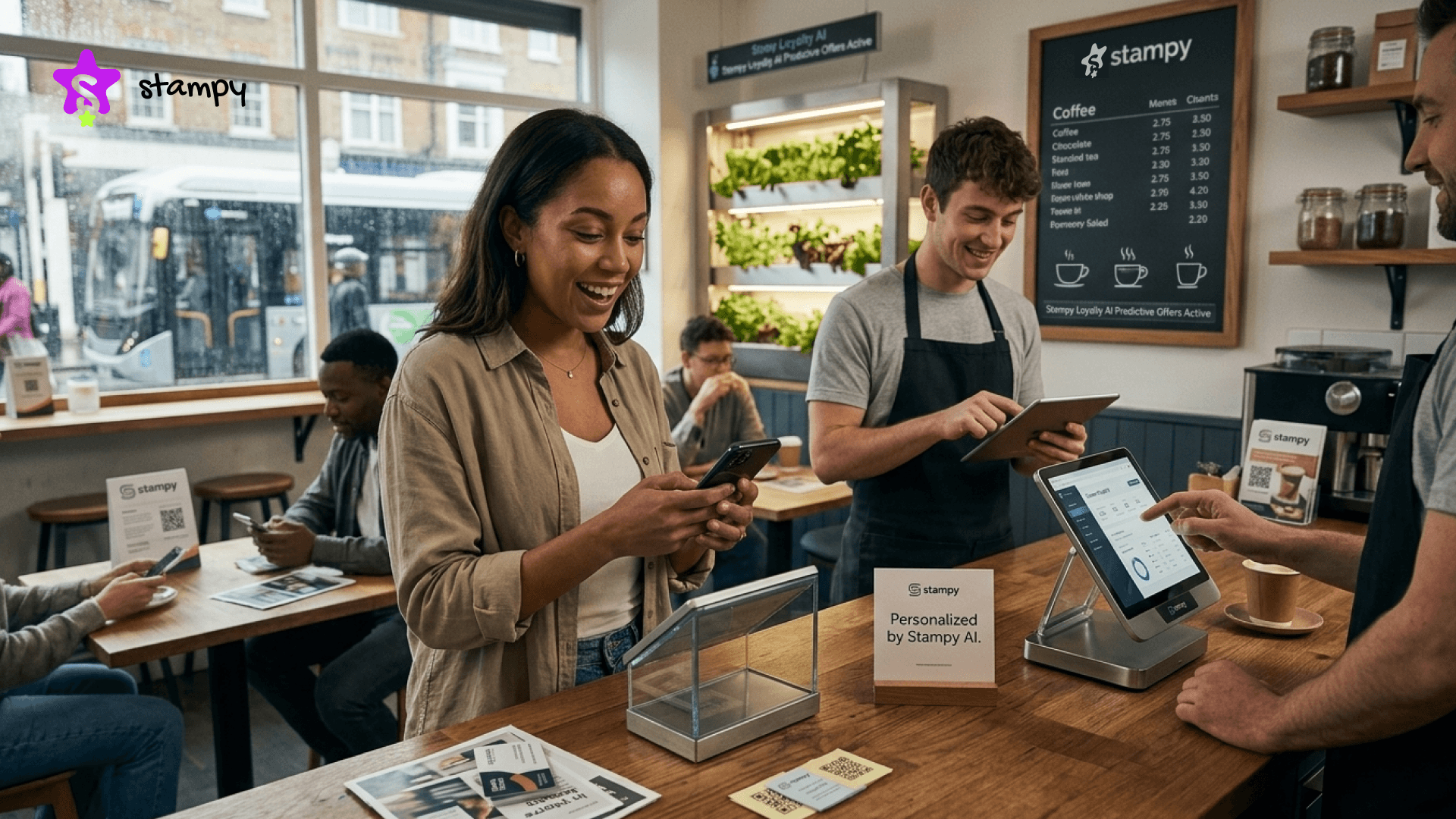
For a small business, AI loyalty could work quietly in the background by turning everyday customer activity into more timely actions. A coffee shop provides a simple example.
Today, a customer collects digital stamps and receives a free coffee after eight purchases. In 2027, an AI layer could notice that they usually visit on Tuesdays and Thursdays, then spot that their Thursday visits are gradually declining.
The system could identify this as a possible churn signal, suggest a relevant bonus based on their past behavior, and measure whether the offer brings them back. Future recommendations could then improve based on how they respond.
The Risks Businesses Need to Manage as AI Enters Loyalty
AI customer retention tools bring real benefits, but they also introduce a few risks worth managing carefully.
- Over-personalization: Relevant offers can feel uncomfortably invasive when personalization goes too far.
- Bad predictions: AI can misread unusual but harmless behavior as a false signal of churn risk.
- Margin problems: An optimized offer can still lose money if underlying business rules stay weak.
- Unequal treatment: Personalization should never drift into inappropriate or unfair discrimination between customers.
- Too much automation: Customers may still need human help and judgment in certain situations.
- Privacy gaps: Customers deserve a clear understanding of how their information supports personalization.
How Businesses Can Prepare Their Loyalty Program for 2027
These steps help businesses move toward AI readiness without requiring a large technology overhaul or replacing their existing loyalty infrastructure.
Start Collecting Clean First-Party Loyalty Data
Collect accurate first-party data from purchases, visits, redemptions, preferences, and campaign responses. Clean, properly organized customer data gives AI reliable signals for personalization, churn prediction, and loyalty decisions while helping businesses avoid unnecessary data collection.
Move Away From One-Size-Fits-All Campaigns
Start with simple customer segments based on behaviors such as visit frequency, spending, or engagement. Gradually move toward more personalized campaigns as your data improves, rather than trying to implement complex individual prediction models immediately.
Track Customer Behavior, Not Just Points
Monitor visits, purchase gaps, redemptions, offer responses, spending patterns, and engagement alongside loyalty points. These behavioral signals can reveal changing customer habits and provide more useful information for personalization and retention decisions.
Build Clear Reward Economics
Define clear reward costs, margins, earning rules, and redemption limits before adding AI-driven recommendations. Automation can optimize loyalty decisions, but it cannot fix a reward structure that already creates unsustainable costs or weak business returns. Our guide to how much a loyalty program costs breaks down software, reward, setup, and other costs small businesses should consider.
Make Your Loyalty Data Portable and Structured
Organize loyalty balances, customer activity, reward rules, and eligibility information in structured formats that systems can access reliably. This becomes increasingly important as AI shopping agents and external services become new customer-facing interfaces.
Keep Humans in Control
Use AI recommendations to support loyalty decisions while keeping people responsible for strategy, margins, brand voice, and customer experience. Human oversight helps businesses catch poor recommendations and keep automation responsible. See our guide on the benefits of a digital loyalty system for customer retention.
Where Stampy Fits Into the Future of Digital Loyalty
The move toward smarter loyalty starts with having customer activity in one digital system and being able to act on it.
Stampy gives small businesses a simple way to manage rewards, customer activity, campaigns, and notifications without building a custom loyalty system.
Businesses can use Stampy’s features to track visits and redemptions, send personalized notifications, and manage loyalty activity from one place.
That digital foundation becomes more useful as loyalty continues to move toward better personalization, automation, and data-driven decision-making.
Conclusion
The future of customer loyalty programs will depend less on adding more points and more on understanding individual behavior.
Predictive signals, hyper-personalized rewards, and AI shopping agents are likely to shape how loyalty programs engage customers by 2027. But none of this replaces good rewards, simple rules, or genuine human service, which still sit at the heart of a strong loyalty program.
Businesses that start collecting clean, structured customer data today will be in a much better position to adapt as loyalty becomes more personalized, predictive, and automated.
Frequently Asked Questions
What is the future of loyalty programs?
The future of loyalty programs involves more predictive, personalized, and automated decisions rather than fixed points and generic discounts. AI will increasingly help businesses choose relevant rewards, predict churn, and time offers around individual customer behavior.
How will AI change loyalty programs in 2027?
AI will help predict which customers might leave, personalize rewards at an individual level, and automate routine loyalty operations. It may also introduce AI shopping agents as a new interface between customers and loyalty programs.
Will AI replace traditional loyalty points and rewards?
No, points and simple rewards will likely remain, but AI will influence which reward appears and when it gets offered. Traditional loyalty programs are gaining an intelligent decisioning layer rather than losing their core structure entirely.
What is predictive loyalty?
Predictive loyalty uses customer behavior signals, such as declining visits or unredeemed rewards, to estimate churn risk in advance. It allows a business to intervene with a relevant offer before a customer fully stops engaging.
What are dynamic loyalty rewards?
Dynamic loyalty rewards adjust based on factors like customer value, churn risk, demand, and previous response to offers. Unlike fixed rewards, they can differ between customers while still following clear, transparent earning rules.
What is agentic commerce?
Agentic commerce describes AI shopping agents that compare products, check loyalty balances, and even complete purchases on a customer's behalf. It requires loyalty programs to expose clear, structured data that software can read and act on.
Will small businesses be able to use AI loyalty programs?
Yes, small businesses can start with simple automation like churn alerts, segmentation, or basic reward personalization built into existing platforms. The goal should be using automation where it simplifies loyalty rather than adopting every available feature.
Is AI personalization safe for customer loyalty programs?
It can be safe when businesses prioritize explicit consent, data minimization, transparency, and clear customer controls throughout. Trust and responsible data practices matter just as much as the predictive accuracy of the AI itself.