12 min read




Key Takeaways
- Loyalty programs can range from free options to thousands of dollars.
- Usage, members, or transaction fees can increase costs as you grow.
- Small businesses may pay for software, rewards, staff, marketing, and integrations.
- Reward costs can become higher than the monthly software fee.
- The right program depends on your business size, customers, and features.
- Total costs should be compared with the extra revenue from repeat purchases.
- Starting simple can help keep loyalty program costs under control.
A loyalty program can cost almost nothing for a paper card or thousands of dollars for a custom build. For small businesses using digital loyalty software, basic plans can range from free tiers to around $100 or more per month, while advanced platforms can cost several hundred dollars monthly.
Rewards, setup, staff time, promotion, integrations, and hardware all shape what you actually spend each month. Many business owners compare advertised subscription prices and then get surprised by reward costs a few months later. The cheapest plan on the pricing page is not always the cheapest program to run over a year.
Before setting your budget, learn how to set up a small business loyalty program, then use the cost breakdown below to understand what you can expect to spend.
How Much Does a Loyalty Program Cost for a Small Business?
Loyalty program cost for small business owners depends mostly on the approach you choose, so here is a quick comparison.
Loyalty Program Approach | Typical Cost Structure | Additional Costs to Consider |
Paper stamp cards | Printing plus replacement cards | Staff time, printing, limited tracking |
Free loyalty software | $0 software tier | Feature or customer limits, rewards |
Small business digital loyalty platform | Monthly subscription | Rewards, optional upgrades |
POS based loyalty | Monthly extra or bundled pricing | POS subscription, hardware, locations |
Ecommerce loyalty platform | Free to monthly subscription | Order volume, customer limits, integrations |
Custom loyalty app | Large upfront development cost | Maintenance, updates, developers |
Enterprise loyalty platform | Custom or high monthly pricing | Implementation, integrations, support |
The approach you choose determines which costs matter most, from simple software and rewards to integrations, staff time, and ongoing management.
What Makes Up the Real Cost of a Loyalty Program?
The monthly price of loyalty software is only one part of your total spending. Your actual cost can also include rewards, setup, staff time, marketing, usage fees, and integrations or equipment.
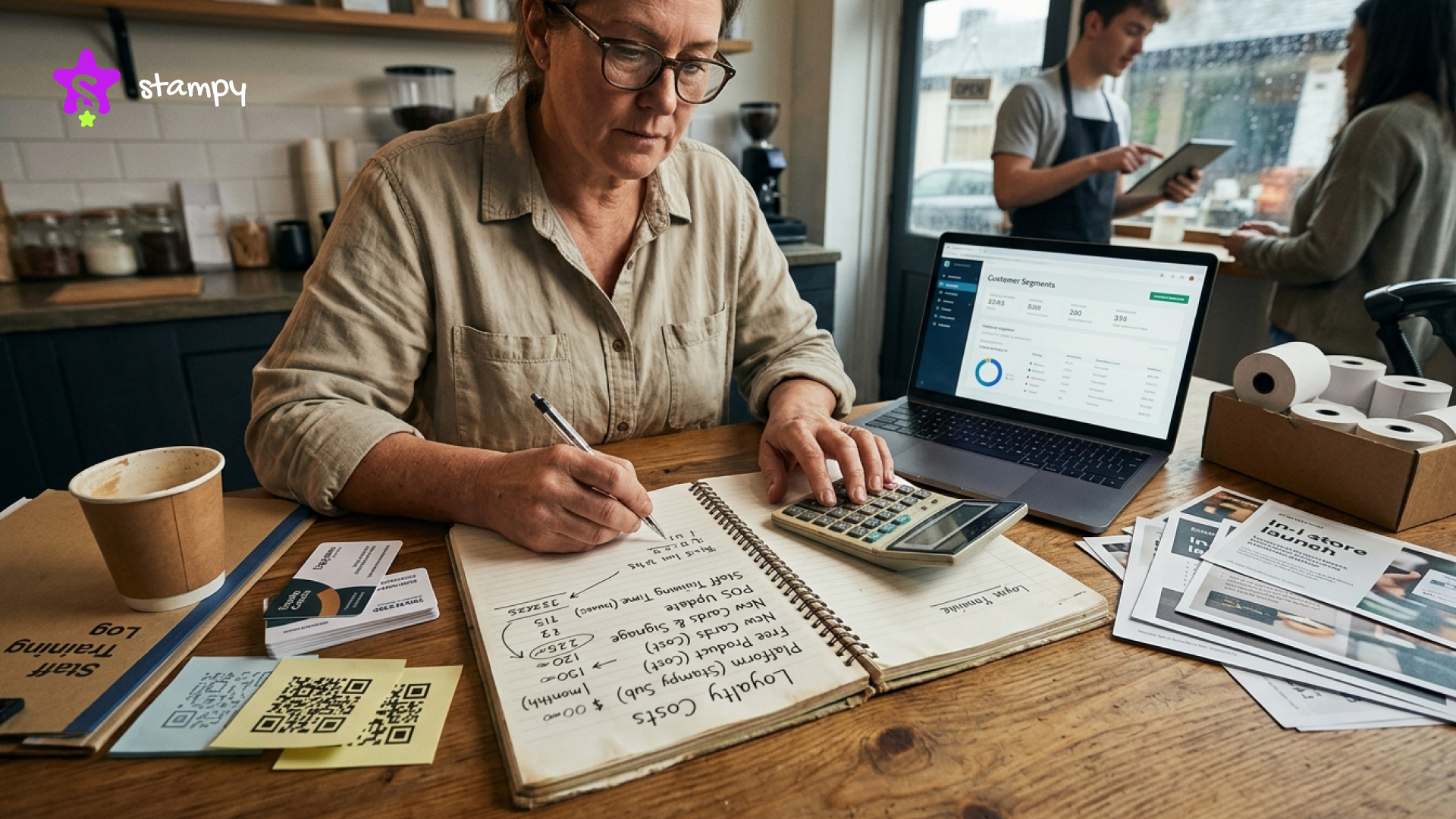
Total Loyalty Program Cost = Software + Rewards + Setup + Staff Time + Marketing + Usage Fees + Integrations and Equipment
Loyalty Software or Platform Fees
Loyalty program software cost usually follows a monthly or annual subscription priced by locations, members, usage, or features. Stampy runs on subscription plans, so you can check current loyalty program pricing.
Reward Costs
Every free product, discount, store credit, cashback, or complimentary service that customers earn is paid for by your business. A cafe giving a free $5 drink after nine purchases should count ingredient cost, not menu price, against those sales.
Setup and Onboarding Costs
Loyalty program setup cost can include account setup, reward configuration, card design, data import, staff training, and customer migration. Basic loyalty software may include setup at no extra cost, while more involved implementations can cost around $100 to $1,000 or more. Enterprise and custom programs can require substantially higher implementation budgets.
Staff and Management Time
Someone has to enroll customers, explain rewards, handle redemptions, review results, create campaigns, and fix the occasional customer issue. This time never appears on a software invoice, which is exactly why so many owners forget to budget for it.
Marketing and Promotion
Promotion costs can include in-store signage, QR materials, email, SMS, paid ads, printed pieces, and launch incentives. You rarely need a big launch campaign, as existing customers can provide your first members. As a benchmark, some small-business models allocate around $125 per month for loyalty marketing, though actual spending varies.
Integrations and Equipment
Depending on the system, you may pay for POS or ecommerce integrations, tablets, scanners, card readers, APIs, or CRM connections. Some standalone loyalty apps, including Stampy, work alongside your existing checkout, so you avoid replacing a POS you already own.
Loyalty Program Cost by Type
Each program format carries a different mix of upfront and ongoing costs, so compare them one at a time.
Paper Punch Card Cost
Paper cards cost little to start, but printing, reprints, physical stamps, replacement cards, and manual admin add up over time. They also capture almost no customer data, as our loyalty app vs wallet pass vs paper card comparison shows.
Digital Stamp Card Cost
Digital loyalty program cost for stamp cards usually means a flat monthly subscription or a free starter plan. Some providers price by locations or features instead, and you trade printing bills for a predictable software fee.
Points-Based Loyalty Program Cost
Points programs may need more tracking, a POS or ecommerce connection, more detailed reward rules, and better reporting. That does not make points universally more expensive, since the final cost depends on the platform and implementation.
POS Loyalty Program Cost
Loyalty may be built into your POS, sold as a paid extra, or unlocked only on higher subscription plans. A fair comparison includes the underlying POS cost, especially if you must adopt or stay inside that ecosystem.
Custom Loyalty App Cost
A custom loyalty app cost covers product design, iOS and Android development, backend work, hosting, security, updates, and developer support. Current cost guides place custom builds in the thousands or tens of thousands upfront, turning software into a technology project.
Don't Forget the Cost of the Rewards
Loyalty program rewards cost is one of the largest overlooked expenses, so each reward type deserves its own quick check.
Free Product Rewards
Calculate free product rewards using your actual product or service cost, not the price printed on your menu or shelf. A $5 latte might cost you $1.50 in ingredients, which changes how generous your reward can safely be.
Percentage Discounts
A 10% discount on a qualifying $50 purchase carries a reward value of $5 for that single transaction. Always measure that discount against your gross margin rather than revenue, because thin margins shrink quickly under repeated discounts.
Store Credit and Cashback
Store credit and cashback reduce the revenue you receive on future purchases, so treat them like cash leaving the till. They are easy for customers to understand, but they need clear expiry rules to keep your liability under control.
Experiential and Low Cost Rewards
Early access, priority booking, free upgrades, members-only items, and bonus stamps give customers value without a large cash cost. Loyalty specialists separate predictable technology costs from reward costs like discounts, services, events, access, and referrals.
Hidden Loyalty Program Costs to Check Before You Sign Up
Loyalty program pricing pages rarely list every charge, so check these items before you commit to any plan.
- Setup fees: Some platforms charge a one-time onboarding fee that never appears in the monthly price shown online.
- Location charges: Per-location pricing can double or triple your bill the moment you open a second shop.
- Member limits: Customer or member caps force an upgrade once your program grows, often to a much pricier tier.
- Usage fees: Per-transaction charges and SMS fees scale with activity, so busy months cost more than quiet ones.
- Integration costs: POS integration charges and required hardware can add hundreds before you enroll your first customer.
- Premium extras: Premium support, design customization, data migration, and extra staff accounts are often billed separately from the base plan.
- Feature upgrades: The feature you need most, like referrals or analytics, may sit behind the next paid tier.
- Contract terms: Annual contracts and strict cancellation terms can lock you into paying for a program you stopped using.
Example Loyalty Program Budgets
These example budgets are illustrative only, not industry averages, and they show how spending scales with business size.

Example 1: Single Location Coffee Shop
A small coffee shop might spend $30 on software, $60 on redeemed rewards, and $20 on promotional materials in a month, for a total of $110. Actual costs vary by platform, customer participation, and reward usage.
Example 2: Salon
A salon budget usually combines a digital loyalty subscription, referral rewards, customer messaging costs, and a little staff time. Because services carry higher ticket values, one free treatment costs more than a coffee, so reward rules matter.
Example 3: Multi-Location Business
A business with several sites usually needs a higher software tier, extra locations, more team logins, and advanced analytics. Basic multi-location programs can move into the hundreds of dollars per month, while larger programs can cost considerably more depending on usage and integrations.
How to Calculate the Cost of Your Own Loyalty Program
Four short steps give you a realistic monthly figure that you can compare against the extra revenue the program brings.
- Fixed costs: Add your software subscription, integration fees, and any other recurring charges that arrive every month.
- Reward estimate: Multiply the average cost per redeemed reward by the number of redemptions you expect each month.
- Operating costs: Include staff time, admin work, and promotion spend if those amounts are large enough to matter.
- Monthly total: Add the three figures together to get your complete loyalty program monthly cost in one number.
Example: $30 software + $80 rewards + $20 promotion = $130 monthly program cost
When Does a Loyalty Program Pay for Itself?
Loyalty program ROI matters more than the price tag, so compare the profit from repeat purchases with the total program cost.

Break-even additional revenue = Total loyalty program cost ÷ Contribution margin
In simple terms, this shows how much additional revenue you need to cover the program's cost after accounting for your margin. A cafe with a $130 program cost and a 60% contribution margin would need about $217 in additional sales to break even.
Track repeat purchase frequency, member visit frequency, redemption rate, and average transaction value. Compare these metrics with your program costs to see whether loyalty members are generating enough additional revenue.
How to Keep Loyalty Program Costs Under Control
Most overspending comes from launching too much too soon, so these five habits keep your rewards program costs in check.

- Start simple: Launch with one clear reward rather than points, tiers, referrals, and gamification all on day one.
- Right-size: Choose a platform built for your current size instead of paying for enterprise features you will not use.
- Protect margins: Calculate the true cost of each reward before launch, so generosity never quietly eats your profit.
- Skip hardware: Avoid new tablets or scanners when a QR code or app-based option works with your existing checkout.
- Read limits: Free can mean permanently free, capped customers, restricted features, or only a trial that ends in weeks.
Our comparison of the best free digital loyalty apps for small businesses explains those differences before you pick one.
How Much Does Stampy Cost?
Stampy uses predictable subscription pricing that currently starts at $19.99 per month for a single location plan. Higher plans cover businesses needing more locations and capabilities, and a 30-day free trial lets you test everything first. Prices and features can change, so check Stampy pricing for the live plan details before you decide.
There are no complex setup requirements or dedicated loyalty hardware to add to your budget. You can start with the features your business needs and scale your plan as your customer base and locations grow.
Conclusion
A loyalty program does not have to be expensive to be effective. For most small businesses, the highest cost is not the software subscription itself but the rewards, staff time, marketing, and other expenses that grow as participation increases. Before choosing a platform, calculate the full monthly and yearly cost based on your expected usage and reward redemptions. Start with the features your customers actually need, then expand as your program grows. The goal is not to find the cheapest loyalty software, but to build a program that encourages repeat purchases while keeping reward costs and operating expenses under control.
Frequently Asked Questions
How much does a loyalty program cost per month?
Small business loyalty software can range from free plans to around $100 or more per month, while advanced platforms can cost several hundred dollars monthly. Your total cost also depends on rewards, usage, messaging, integrations, and staff time.
What is the cheapest type of loyalty program?
Paper punch cards are usually the cheapest to start because they only require printing and rewards. Free digital loyalty plans can also cost $0, although they may have customer, feature, or usage limits.
How much does loyalty program software cost?
Loyalty program software cost ranges from free starter tiers to several hundred dollars monthly for advanced multi-location platforms. Custom builds sit far above that range, because you are paying developers rather than subscribing to finished software.
Are there free loyalty programs for small businesses?
Yes, several providers offer free plans, but most cap the number of customers, locations, or features you can use. Check whether free means forever or just a trial, and compare the upgrade price you will eventually face.
How much should a business spend on loyalty rewards?
There is no fixed rule, but many businesses keep reward costs to a small share of member revenue. Work from your gross margin, then set a reward that customers value without pushing your profit per visit negative.
Does a loyalty program need expensive software?
No. Many small businesses can start with simple digital loyalty tools costing under $50 per month, while more advanced platforms can cost considerably more. The right choice depends on features, customer volume, locations, and integrations.
Are digital loyalty programs cheaper than paper cards?
Digital programs cost more upfront because of the subscription, but they remove printing, reprints, and lost card headaches. Over a year, the customer data and automation usually deliver more value than the small monthly fee costs.
How do I know if my loyalty program is worth the cost?
Compare the profit from extra repeat purchases with your total program cost, including software, rewards, and staff time. If members visit more often and spend more than other customers, the program is likely paying for itself.