13 min read




Key Takeaways
- Customers should know exactly when they can redeem, what they can get, and how redemption works.
- Minimum redemption thresholds should fit normal customer behavior rather than feel permanently out of reach.
- Point values and reward requirements should stay easy to understand and consistent wherever possible.
- Restrictions, exclusions, expiry, and offer stacking rules should be visible before customers reach redemption.
- Businesses need clear rules for refunds, cancellations, unavailable rewards, and suspected abuse.
- Material changes should be communicated clearly rather than surprising customers after they have already earned progress.
- Track actual redemption behavior, since unused rewards often signal friction rather than a successful program.
Good loyalty reward redemption rules should answer a few basic questions before a customer reaches checkout: what have I earned, when can I use it, and what can I use it for?
Keep reward thresholds realistic, make the value easy to understand, and explain important restrictions before customers start earning. Customers should not have to discover minimum spends, excluded products, or expiry conditions only when they are ready to redeem.
The redemption itself should be just as simple. If customers complete the required steps but then face a complicated process, the reward can lose its appeal. For guidance on building the wider program, see our guide on how to launch a loyalty program, which covers the earning structure separately.
What Should Loyalty Redemption Rules Tell the Customer?
Before customers try to redeem a reward, they should already know what they earned, when it becomes available, and where they can use it. A customer should be able to answer when they can redeem, what reward they get, and how they actually claim it. They should also know where they can use it, what restrictions apply, and whether it expires eventually.
Clear loyalty program redemption rules, including specific loyalty points redemption rules where points are involved, prevent this kind of confusion. If a customer needs to ask staff several questions at checkout, the redemption rules are probably too complicated already.
10 Loyalty Reward Redemption Rules to Set Before Launch

These ten reward redemption rules cover the decisions every loyalty program needs before it actually launches.
1. Set a Clear Redemption Threshold
Define exactly when the reward unlocks, such as collecting 8 stamps for one free qualifying drink, or reaching 500 points for a $5 reward. These points redemption rules and broader loyalty program reward rules should stay fixed once published. Avoid moving thresholds or unclear formulas that confuse customers partway through earning. A threshold can protect margins, but making the first useful reward too distant can genuinely reduce participation. If customers have to wait too long to reach a useful reward, participation can fade. See why customers stop using loyalty cards for more on the friction that can cause customers to disengage.
2. Make the Reward Value Easy to Understand
For stamp programs, this usually stays simple, such as 8 stamps equaling one free coffee without any further math. For points, customers should understand the conversion clearly, like 100 points equaling $1 consistently. Research from the American Marketing Association found fixed points-to-money exchange rates produced more redemption than variable rates.
This does not mean every program needs a cash equivalent value, only that clarity itself genuinely matters. A clear reward redemption policy makes loyalty points redemption feel predictable, which helps more customers actually redeem loyalty rewards instead of letting them sit unused. The right reward structure also depends on how customers naturally make purchases. Compare stamps vs. points loyalty programs to see how each approach works in practice.
3. State Exactly What the Reward Can Be Used For
Avoid advertising a free item broadly, then revealing at checkout that only two low-priced products actually qualify. Specify eligible products, excluded categories where necessary, and whether upgrades or substitutions are genuinely possible. A clear example might read: 1 regular drink up to $6, with premium add-ons charged separately. The goal is not eliminating every restriction, but eliminating loyalty reward restrictions that surprise customers unexpectedly.
4. Decide Whether Partial Redemption Is Allowed
This matters particularly for points and store credit-style rewards where customers hold a larger balance. Imagine a customer holding a $10 loyalty reward and wondering whether they can use $4 today and keep the remaining $6 for later. Neither approach is universally right, but customers should know the answer well before checkout. If partial redemption is not possible, state that clearly on the reward itself.
5. Decide Whether Rewards Can Be Combined With Other Offers
Define whether customers can use a loyalty reward alongside sale prices, coupons, birthday offers, or other promotional bundles. Avoid vague language like cannot be combined with selected offers, since customers cannot easily discover what that actually excludes. A clearer version reads: one loyalty reward per transaction, and rewards cannot be combined with percentage-off promotional codes. Real loyalty terms commonly define offer stacking explicitly, rather than leaving it to staff discretion at the register.
6. Make Expiry Rules Visible and Reasonable
Clear loyalty points expiry rules and loyalty reward expiration terms prevent frustration long before a customer loses anything. If points or rewards expire, explain what expires, when, and whether expiry follows the earning date or ongoing inactivity. State what activity resets the clock, whether customers receive a reminder, and what happens once expiry actually occurs. Point or stamp expiry can differ meaningfully from an already unlocked reward's own expiry window.
A 6-month inactivity period means something very different for a weekly coffee customer than for a salon client with a longer natural return cycle. There is no single universal expiry period, since purchase cycles and legal requirements vary considerably by business and jurisdiction. Written loyalty program expiry rules should reflect this reality rather than copying a generic industry default.
7. Define What Happens After Returns, Refunds, or Cancellations
Consider a customer who earns 100 points from a purchase, then later returns that same purchase entirely. A consistent rule might deduct points earned from a refunded transaction directly from the customer's balance. Then consider what happens if the customer already spent those points before the return occurred. The important part is deciding this rule before launch and applying it consistently whenever a purchase is refunded. For service businesses, adapt this same logic to canceled appointments, refunded bookings, or reversed transactions generally.
8. Define Where Customers Can Redeem
State clearly whether rewards work in-store, online, inside the app, or only at specific participating locations. For multi-location businesses, answer directly whether a customer can earn at one branch and redeem at another entirely. Avoid forcing customers to discover branch restrictions only once they reach checkout somewhere unexpected. Stampy's current platform allows customers to earn and redeem across connected locations without this kind of confusion.
9. Decide What Happens When a Reward Is Unavailable
Picture a customer whose earned reward is a free pastry, but every qualifying pastry happens to be sold out that day. Possible approaches include substituting an equivalent reward, letting the customer keep their earned reward, or allowing redemption next visit. Never mark a reward as redeemed if the customer did not actually receive anything in return. The exact policy depends on your business, but staff genuinely need one consistent rule to follow.
10. Set Rules for Fraud, Duplicate Redemption, and Account Sharing
The redemption should be easy enough for real customers, but properly verified behind the scenes. Explain what happens in the event of a duplicated reward code, a shared restricted account, or a reward being redeemed twice. Anti-fraud rules should be proportionate, because too many verification steps will frustrate legitimate customers trying to redeem normally. Stampy’s current system uses verified QR scans and logs redemption activity instead of manually verifying paper.
Be Careful When Changing Redemption Rules

Changing rules for future earning differs meaningfully from changing the value of progress customers have already earned.
Imagine a business wants to change 8 stamps for a free drink into 10 stamps for that same free drink. Before changing anything, decide what happens to customers already sitting at 7 stamps under the old rule.
Decide exactly when the new rule begins, whether existing progress gets grandfathered, and how customers will be notified. Avoid silently changing the finish line on customers who are already most of the way there.
Keep the Actual Redemption Process Short
A well-written set of loyalty reward terms and conditions still fails if the actual reward redemption process feels slow. Rules can look entirely fair on paper and still fail badly once customers try to actually use them.
Clearly documented loyalty program exclusions prevent most of the confusion that slows this process down at checkout. The ideal flow stays close to this: the reward unlocks, the customer shows it, staff verifies it, and the reward applies instantly. Avoid flows that require opening an app, finding a hidden menu, generating a voucher, and waiting for manager approval.
In Stampy's current flow, the reward appears automatically once the required stamps are completed by the customer. The customer then presents their reward QR code, staff scans it, and the redemption gets recorded immediately.
Write Redemption Rules Customers Can Actually Read
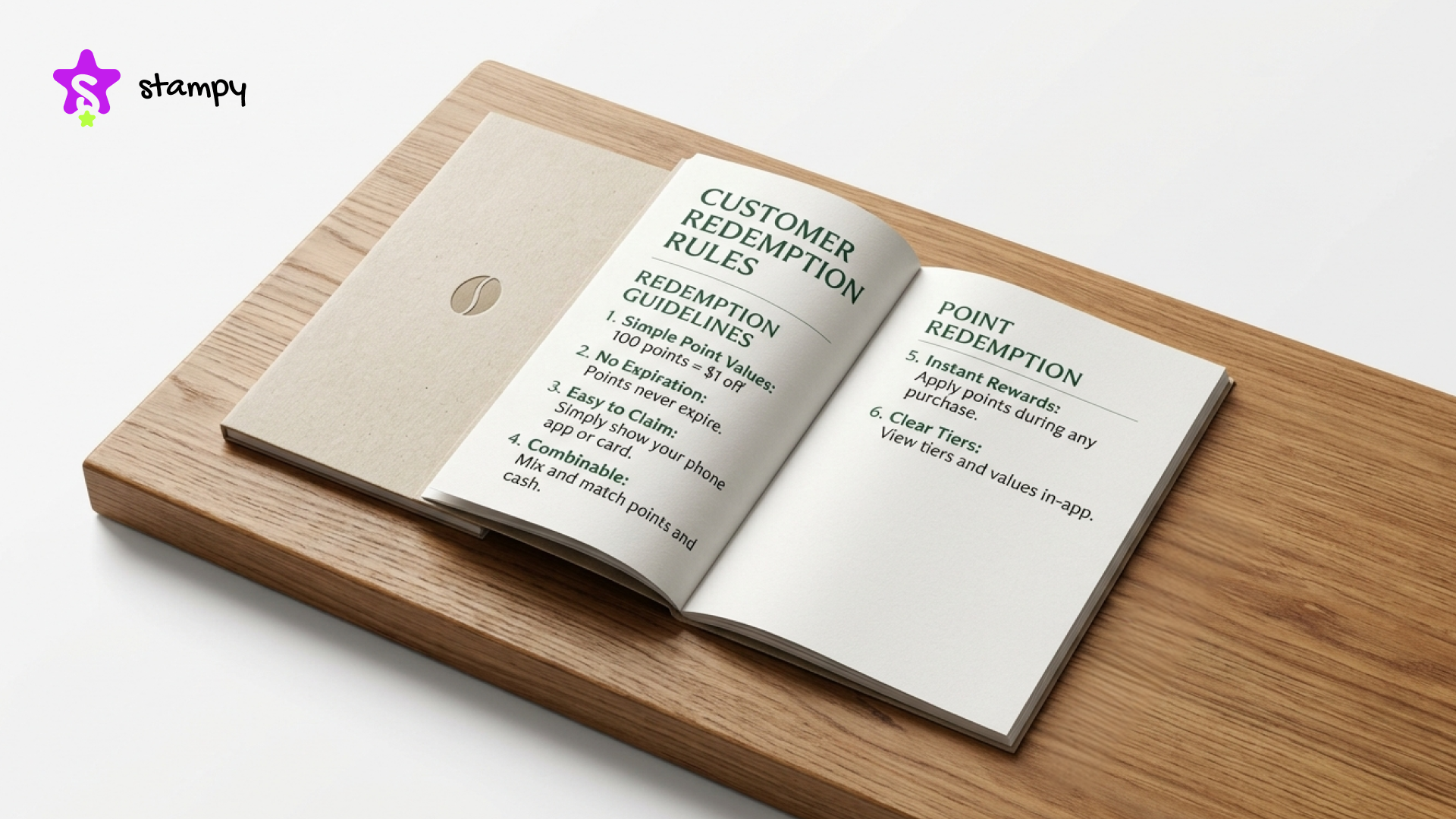
Putting every operational detail on the front of a loyalty card overwhelms customers who just want the basics. Keep a short customer-facing summary, such as collect 8 stamps, get one free qualifying drink, redeem at any participating location, one reward per transaction.
Important restrictions should also appear where customers make redemption decisions, such as on the reward screen or before checkout. Customers should not have to search through lengthy terms to find a rule that affects whether they can use their reward.
Save full program terms for a separate document covering eligibility, earning, redemption, exclusions, expiry, refunds, fraud, and program changes. This keeps the everyday experience simple while the complete rules stay properly documented.
Redemption Rule Examples for Different Loyalty Programs
These examples show how redemption rules actually read once written out for real customers.
A digital stamp card might read earn one stamp with each qualifying purchase, collect 8 stamps to unlock one free qualifying item, and show your reward at checkout. A points program might read: earn one point per dollar spent, with 500 points unlocking a $5 reward at checkout. A salon visit program might read: earn one stamp after each qualifying appointment, with 6 visits unlocking a complimentary add-on.
A restaurant reward might read: complete 5 qualifying visits and unlock a free dessert from the participating menu. These examples are meant to show how the rules might appear to customers, not replace your full program terms. If you are deciding between these two reward mechanics, stamps vs. points loyalty programs break down the differences in how customers earn and use rewards. For a practical example, see how a coffee shop loyalty program can turn a simple visit-based reward into a digital customer experience.
Quick Redemption Rules Checklist

Run through this checklist before launching any new loyalty program or updating existing redemption rules.
- Earning clarity: Customers know exactly what earns the reward, with no ambiguity at checkout.
- Threshold stated: The redemption threshold is clearly stated and genuinely achievable for regular customers.
- Value understood: Reward value is understandable, whether measured in stamps, points, or a direct dollar figure.
- Eligibility defined: Eligible products or services are clearly defined, including any necessary exclusions upfront.
- Stacking clear: Offer stacking rules are clear, so customers know what combines with other promotions.
- Partial rules set: Partial redemption rules are clear wherever that situation could realistically apply.
- Expiry explained: Expiry is clearly explained, including what triggers it and how customers get notified.
- Refunds handled: Refund and cancellation handling is defined consistently across every transaction type.
- Locations stated: Participating locations and channels are clearly stated, avoiding checkout surprises entirely.
- Fraud rules exist: Fraud and duplicate redemption rules exist without making genuine customers feel distrusted.
- Staff consistency: Staff can explain redemption consistently, regardless of who happens to be working.
- Changes communicated: Customers are told about material rule changes before those changes actually take effect.
Conclusion
Good redemption rules protect the business without making customers work for rewards they have already earned. Keep thresholds achievable, make reward values easy to understand, disclose restrictions before redemption, and keep the process quick. Test the full customer journey before launch, from earning the reward to using it at checkout. If customers regularly earn rewards but rarely redeem them, review the threshold, reward value, expiry, and redemption experience to identify where unnecessary friction may be getting in the way.
Frequently Asked Questions
What are loyalty reward redemption rules?
Loyalty reward redemption rules are the specific conditions customers must meet to claim an earned reward successfully. They cover thresholds, eligible items, expiry, locations, and what happens when a reward cannot be fulfilled as promised.
What should a loyalty program redemption policy include?
A complete loyalty rewards policy would include the redemption threshold, the value of the reward, items that are eligible, terms of expiry, how refunds are handled and fraud rules. It should also clearly explain where customers can redeem and what happens if their selected reward becomes unavailable.
How do customers know how to redeem loyalty rewards?
Clear, short instructions at the point of earning help customers understand how to redeem loyalty rewards without confusion later. A simple customer-facing summary works better than burying the process inside lengthy full program terms.
Should loyalty rewards have a minimum redemption threshold?
Yes, a minimum threshold helps protect margins, but it should match normal customer behavior rather than feel unreachable. Setting the threshold too high discourages participation, while setting it too low can undermine the program's overall value.
Should loyalty rewards expire?
Expiry can work well, but the exact period should reflect your actual purchase cycle rather than a generic industry default. A weekly coffee customer and an occasional salon client need very different expiry windows to feel genuinely fair.
Can loyalty rewards be combined with discounts?
It depends entirely on your program rules, but the policy should state this clearly rather than leaving it to staff discretion. A specific rule, such as one reward per transaction, prevents confusion better than a vague stacking restriction.
What happens to loyalty points after a refund?
Most programs deduct points earned from a refunded transaction directly from the customer's balance once the return is processed. Businesses should also decide in advance what happens if those points were already spent before the refund occurred.
Can a business change its loyalty redemption rules?
Yes, but changes to future earning should stay separate from changes affecting progress customers have already earned honestly. Clear communication and a defined transition date help avoid frustrating customers who are already close to a reward.
Can rewards be redeemed at every location?
Only if the program permits cross-location redemption, which businesses need to define clearly before launch. For businesses with several branches, learn how to run the same loyalty program across multiple locations while keeping rewards, rules, and reporting consistent.
What is a good loyalty reward redemption rate?
Redemption rates vary by industry and purchase frequency, so there is no universal number that defines a successful program. If customers frequently earn rewards but rarely redeem them, review the threshold, expiry, reward value, and redemption process for possible friction.
How can businesses make loyalty rewards easier to redeem?
Keep the threshold achievable, state the reward value clearly, and reduce the redemption process to as few steps as possible. Automating reward unlocks and using QR-based verification, rather than manual codes, removes unnecessary friction at checkout.