13 min read




Key Takeaways
- POS loyalty connects rewards to checkout and can automate earning from transaction details.
- Standalone loyalty apps can manage rewards separately from your existing POS.
- Both approaches may offer campaigns, notifications, analytics, and multi-location tools.
- Without integration, staff may need to verify purchases and record loyalty activity separately.
- Choose the system around your reward rules, checkout process, costs, and customer experience.
POS loyalty and standalone loyalty apps both help businesses reward customers and encourage another visit. The main difference is how they connect with checkout.
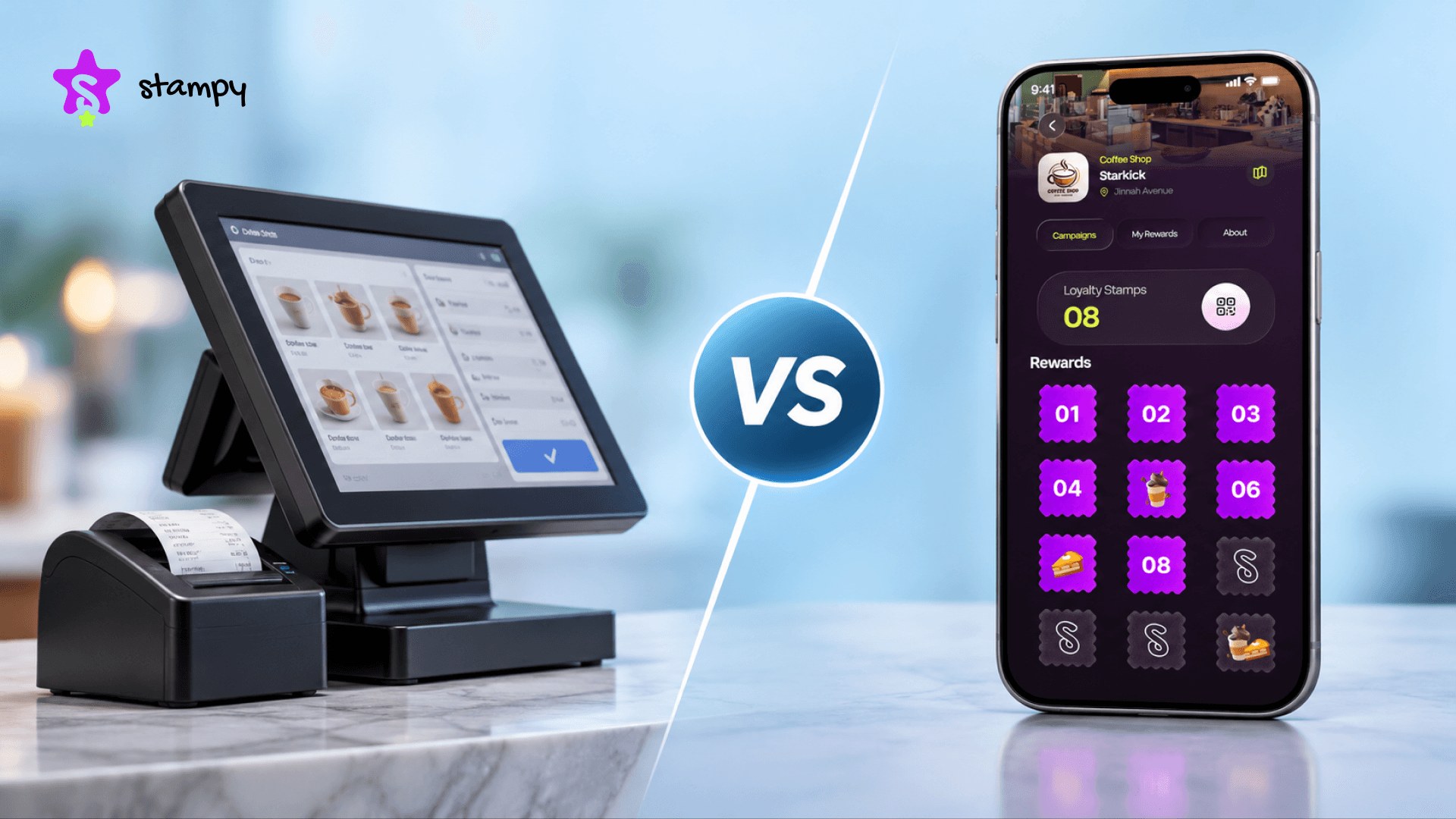
A POS loyalty program uses purchase information from your point-of-sale system to manage earning and redemption. A standalone app can run separately, allowing you to keep your current checkout while managing loyalty through another platform.
For example, a retailer awarding points for every dollar spent may value automatic transaction tracking. A café offering a stamp for each qualifying coffee purchase may be comfortable with a separate scan.
Neither approach is automatically better for customer retention. The useful choice is the one your customers understand and your team can run consistently.
Here is how they compare.
What Is a POS Loyalty Program?
A POS loyalty program connects customer rewards to the system that records sales and processes purchases.
Once a customer is identified, the system can use eligible transaction details to calculate progress towards a reward.
For example:
Earn one point for every dollar spent on qualifying purchases.
The POS already holds the purchase amount, so a supported loyalty feature can calculate points without staff entering that amount again.
Depending on the provider, the system may also support item-based rewards, exclusions, redemption at checkout, and adjustments after refunds.
Check those details before choosing a platform. Full refunds, partial refunds, and the return of an item purchased with a reward may follow different rules.
How POS Loyalty Works
A typical process looks like this:
- The customer identifies their loyalty account.
- Staff process the purchase through the POS.
- The system checks the earning rules.
- Eligible points or reward progress are added.
- Available rewards can be applied through the supported checkout process.
The main advantage is the connection between the sale and the loyalty activity.
This can be useful when earning depends on spending, individual products, or other transaction details.
What Is a Standalone Loyalty App?
A standalone loyalty app manages rewards independently from the checkout software.
Customers pay through the business’s usual system. Staff then verify the qualifying purchase and record the loyalty activity separately.
For example:
Buy six qualifying coffees and earn a free regular coffee.
Staff can check the purchase and scan the customer’s loyalty code to add a stamp.

The loyalty platform records that activity, while the POS records the sale. Without a connection between them, the app may not automatically receive the amount spent or the items purchased.
Some standalone platforms offer optional integrations. Others are designed to operate without them.
The word “standalone” describes the platform’s independence; it does not mean integration is always unavailable.
For a practical explanation, read our guide to running a loyalty program without POS integration.
POS Loyalty vs. Standalone Loyalty Apps: Side-by-Side Comparison
Area | POS Loyalty | Standalone Loyalty Without Integration |
Checkout connection | Connected to the supported POS | Operates separately |
Purchase information | Can use eligible transaction details | May require separate recording or entry |
Spend-based points | Can calculate from the sale | May need staff to enter the amount |
Digital stamps | Available with some providers | Available with some providers |
Product exclusions | May use item-level purchase data | Staff may need to check eligibility |
Refund adjustments | Can be automated under supported rules | May require a separate adjustment |
Reward application | May happen directly in checkout | Staff may need to apply the benefit separately |
Campaigns and notifications | Provider-dependent | Provider-dependent |
AI features and analytics | Provider-dependent | Provider-dependent |
Multi-location support | Depends on compatibility and account setup | Depends on branch and account features |
Changing POS | May require migration or reconfiguration | Loyalty may continue separately, subject to provider terms |
Compare the actual features rather than assuming one category provides better marketing tools.
A POS platform may include detailed customer reporting and campaigns. A standalone app may offer a basic stamp card or a broader set of engagement features.
What Changes at Checkout?
Checkout is where the difference becomes most visible to staff and customers.
With POS Loyalty
The earning process can happen within the sale.
This can reduce repeated entry when rewards depend on order value or purchased items. Staff still need to follow the correct customer-identification and redemption process.
Ask the provider to demonstrate a normal purchase, a reward redemption, and a refund. Seeing those steps is more useful than being told that the system is fully automated.
With a Standalone App
Staff usually perform a separate loyalty action after checking the purchase.
For a stamp program, that may be a quick scan. For spending-based points, it could involve entering a purchase amount.
Consider how that fits your busiest service period. A process that feels easy during a demonstration may take longer when several customers are waiting.
Test it with the devices and staff members who will use it.
Which Rewards Suit Each Approach?
The reward structure helps determine how much purchase information the loyalty system needs.
Spend-Based Points
Points linked to spending need an accurate purchase amount.
For example:
Earn one point for each dollar spent, excluding selected items.
A suitable POS connection can make that easier to administer. Without integration, someone may need to enter the eligible amount and account for exclusions.
Product-Based Rewards
Offers tied to specific products also benefit from reliable item information.
For example, a business might award extra points on one product while excluding another.
Without integration, staff need a clear way to check which items qualify.
Stamps and Visit-Based Rewards
A stamp for a qualifying purchase can be simpler to record separately.
The business still needs to define what counts. “One stamp per qualifying main meal” means something different from “one stamp per transaction.”
Our stamps vs. points comparison explains how purchase frequency and order value can influence the choice.
Can Standalone Loyalty Apps Help With Customer Engagement?
Depending on the platform, a standalone app may include more than reward tracking.
Features can include:
- Customer reward progress.
- Campaign management.
- Notifications.
- Visit and redemption history.
- Customer groups.
- Branch reporting.
These tools can help a business stay connected between purchases.
For example, a member who has almost completed a card could receive a progress reminder. Another member might be eligible for a return offer.
POS loyalty platforms may provide similar capabilities. Compare which features are included, how customer groups are created, and whether messaging carries additional charges.
Also consider the joining experience. A dedicated app, wallet pass, and phone-number-based account ask different things of the customer.
Our guide to loyalty apps, wallet passes, and paper cards compares those formats.
Where Do AI Campaigns Fit In?
AI features are separate from the question of POS integration.
Either type of platform may use AI to analyse recorded activity or recommend campaigns. The available capabilities depend on the provider and its data.

Possible uses include identifying changes in visit frequency, reviewing reward progress, or suggesting an audience for an approved offer.
For example, a system might flag customers whose recorded visits have declined. The business could then investigate whether a reminder or return offer is worth testing.
Check what the system can see. A scan-based app may know that a customer earned a stamp without knowing the complete contents of the order. An integrated system may have more detailed purchase information.
Ask what data supports each recommendation and how the provider measures its usefulness.
For more context, explore how AI is transforming digital loyalty programs.
What Customer Insights Should You Look For?
Useful reporting should answer questions about how people use the program.
Look for information such as:
- How often identified members return.
- How long they take to complete a reward.
- Which rewards they redeem.
- Where participation drops.
- How activity differs between branches.
- What happens after a campaign.
Interpret those figures within the limits of the data.
A missing loyalty scan does not necessarily mean a customer made no purchase. Similarly, a large membership count does not show that members are actively earning or redeeming.
If participation is weak, review the earning requirement and customer experience before adding more promotions.
Our article on why customers stop using loyalty cards covers common sources of friction.
What Does Research Say About Loyalty Program Effectiveness?
A meta-analysis published in the Journal of the Academy of Marketing Science examined 429 effect sizes from research published or available between 1990 and 2020.
The researchers found evidence that loyalty programs improve customer loyalty, particularly purchasing behaviour. However, effectiveness varied with program design and industry, and changing customers’ attitudes towards a business was more difficult. See “40 Years of Loyalty Programs: How Effective Are They?”.
The research does not establish that POS loyalty outperforms standalone apps, or the reverse.
For business owners, the useful implication is to assess how the program works in practice. The reward, earning rules, and delivery experience deserve as much attention as the software category.
Which Option Works Better Across Multiple Locations?
Both approaches can support several branches, provided the platform and account setup allow it.

A POS loyalty program may work across compatible locations within the same system.
A standalone platform may let businesses keep different checkout systems while sharing a loyalty program. That flexibility can be useful, but it still requires consistent rules and staff procedures.
Before choosing either option, confirm:
- Whether customers use one account across branches.
- Where they can earn and redeem.
- Whether reward progress updates across locations.
- Which reports each manager can access.
- How reward costs are handled between branches.
A shared program needs clear commercial arrangements as well as software support.
Our guide to running one loyalty program across multiple locations covers these decisions in more detail.
What Happens if You Change Your POS?
Changing checkout providers can affect an integrated loyalty program.
You may need to move customer records, transfer balances, rebuild reward rules, or introduce a different redemption process.
A standalone platform may continue operating separately, but confirm what can be exported and how customers access their rewards.
Ask both providers about:
- Customer-record exports.
- Stamp or points balances.
- Unredeemed rewards.
- Campaign history.
- Marketing preferences.
- Migration support and charges.
Do not assume that an export includes everything needed to recreate the program elsewhere.
Compare the Full Cost
The software subscription is only part of the cost.
POS Loyalty Costs
Depending on the provider, you may pay for:
- A loyalty add-on or higher software tier.
- Usage or location charges.
- Compatible equipment.
- Messaging.
- Setup and training.
- Integrations.
If loyalty requires changing your POS, include the wider cost of that change.
Standalone Loyalty Costs
A standalone platform may involve:
- A subscription.
- Additional branch or user charges.
- Staff time for separate loyalty actions.
- Messaging.
- Setup or migration.
- Optional integrations.
Without integration, manual checks and adjustments can also take time.
Both approaches carry reward costs. Compare the complete offer, including welcome bonuses and any discounts members can combine.
Our guide to loyalty program costs explains what to include in the budget.
When POS Loyalty May Be the Better Fit
Consider POS loyalty when:
- Earning depends on spending or specific products.
- You want rewards handled within checkout.
- Manual purchase entry would create too much work.
- Your current POS provides the loyalty features you need.
- You expect to keep the same checkout system.
- Supported refund handling matches your rules.
This can suit a business with varied order values or detailed product exclusions.
Check the actual workflow before deciding. Integration is useful when it removes work your team would otherwise need to perform.
When a Standalone Loyalty App May Be the Better Fit
Consider a standalone app when:
- You want to keep your existing POS.
- A simple stamp or visit-based reward meets your needs.
- Staff can record qualifying activity reliably.
- The platform offers the campaigns and reporting you need.
- You want loyalty managed separately from checkout.
- Participating branches use different POS systems.
A café could use a separate scan to record qualifying coffee purchases without transferring the full transaction.
That approach becomes less convenient if every purchase needs a different points calculation or several item-level checks.
Test the Program Before Choosing
Ask for a demonstration using your own reward rules.
Then test the customer and staff experience from joining through to redemption.
Check a Normal Purchase
Confirm how the customer identifies their account, how eligibility is checked, and when progress appears.
Check a Reward Redemption
Make sure staff know how to verify the reward and apply the free item or discount.
Our guide to loyalty reward redemption rules covers conditions worth defining beforehand.
Check a Refund
Ask what happens to earned progress and redeemed rewards after a full or partial refund.
Do not assume both are reversed automatically.
Check the Reporting
Review whether the system answers the questions you need to manage the program.
A useful report should help you decide what to keep or change, rather than simply display a large total.
How Stampy Works Alongside Your Existing Checkout
Stampy lets businesses set up digital stamp campaigns and rewards through its portal without requiring POS integration.
Customers use the Stampy app. After a qualifying purchase, staff scan the customer’s QR code through the Stampy Partner app to add progress. When a reward becomes available, staff scan the reward code to record redemption.
This keeps loyalty activity separate from the sale, so staff still need to verify eligible purchases and handle the reward through the normal checkout process.
You can review the steps in how Stampy works.
Stampy also describes campaign management, customer notifications, activity reporting, and AI-powered recommendations among its features. Check the available functions and limits against your requirements before choosing a plan.
Explore Stampy’s plans and trial options to test the process with your team.
Conclusion
Choose between POS loyalty and a standalone app by looking at how your rewards will work during everyday service. A POS connection can make spending-based points and product-specific rewards easier to manage, while a standalone app can suit a simple stamp program alongside your existing checkout. Compare the full costs and test earning, redemption, and refunds with your team before committing. Either approach should give customers a clear reward and staff a process they can follow consistently.
Frequently Asked Questions
Is POS loyalty better than a standalone loyalty app?
It depends on your earning rules and checkout needs. POS loyalty can make transaction-based rewards easier to automate. A standalone app may suit a simple program that staff can manage separately.
Do standalone loyalty apps require POS integration?
Some operate without it, while others offer optional connections. Confirm how purchases are verified and what staff need to record.
Can POS loyalty platforms include marketing campaigns?
Yes. Some include customer groups, notifications, offers, and reporting. Compare the actual features rather than assuming campaigns are limited to standalone apps.
Can standalone apps use AI?
Some offer AI-assisted insights or campaign recommendations. Those capabilities depend on the platform, available data, and subscription.
Which approach is easier for spending-based points?
A suitable POS connection can calculate points from eligible transaction details. Without integration, staff may need to enter the spending amount separately.
Can a standalone app manage digital stamps?
Yes. Staff can verify a qualifying purchase and record a stamp through the platform’s supported process.
Can customers receive reward notifications?
Both types of platform may support notifications. Check the available channels, contact preferences, usage limits, and messaging charges.
Can one loyalty program work across several branches?
Yes, when the platform supports shared accounts and balances. Define participating locations, redemption rules, staff access, and reward-cost responsibilities.
Do I need to replace my POS to add loyalty?
Not necessarily. Your existing provider may offer suitable loyalty features, or a separate platform may work alongside it. Compare both options before changing checkout.
What should a small business try first?
Define one earning rule and one reward. Test joining, earning, redemption, and refunds, then compare the work and cost involved in each setup.